External vs Internal Cheats: What's the Difference and How Each One Works
Contents
Private cheat listings often carry an external or internal tag. External vs internal cheats offer similar features, but they work in very different ways: one runs next to the game, the other runs inside it. Here is how each type works and what that means for you as a player.
What Is an Internal Cheat?
An internal cheat runs inside the game process. Its code is loaded into the game memory by an injector, usually as a DLL, and operates from within.
Because it sits inside the game, an internal cheat can call game functions and read data directly. That gives internal builds more room: precise aimbots, ESP drawn with the game renderer and changes to game logic.
What Is an External Cheat?
An external cheat is a separate program that never loads into the game. It opens the game process through standard Windows functions and reads the data it needs from memory: player positions, health, items.
Visuals are usually drawn through an overlay, a transparent window on top of the game. Feature sets tend to be narrower, since reading data is far simpler than altering how the game behaves.
External vs Internal Cheats: Side-by-Side
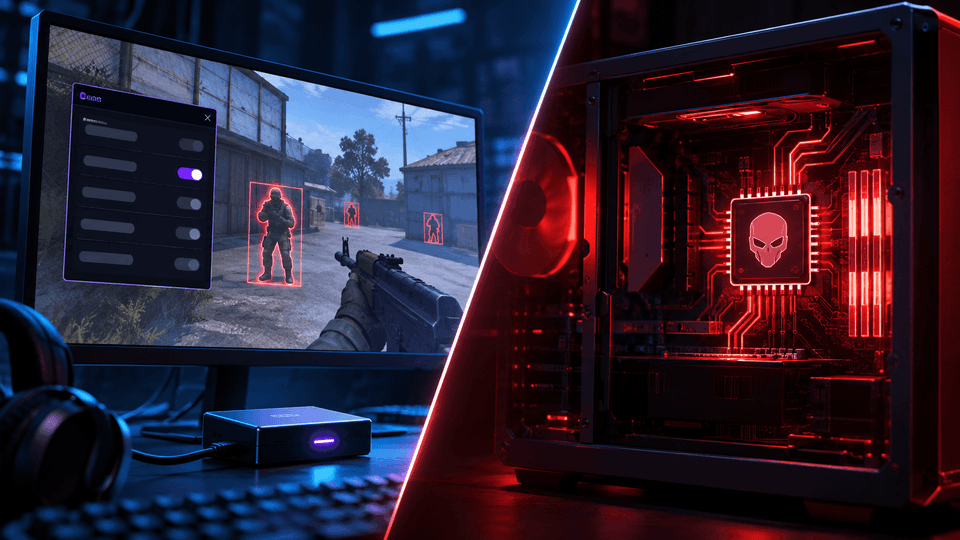
The core difference is where the code runs. Internal cheats live inside the game process, external ones stay outside and only read its memory. Everything else follows from that.
- Where it runs. Internal: inside the game process. External: as a separate program.
- How it connects. Internal: injected by a loader. External: reads game memory from outside.
- Rendering. Internal: through the game itself. External: overlay on top of the window.
- Features. Internal: broader, up to game logic changes. External: mostly data reading, such as ESP and radar.
In practice the developer picks the type for each game and its anti-cheat, and the product page usually states it.
Which Type Is Safer From Bans?
Neither is safe by default. Ban risk depends on how well a specific build hides from a specific anti-cheat, not on the type. External cheats leave game code untouched, but their process and overlay are visible to the system. Internal cheats are integrated deeper, and anti-cheats look for injection traces. The undetected status tells you more than the external or internal label.
Where Do DMA Cheats Fit In?
A DMA cheat moves the work to separate hardware: a card in the gaming PC passes memory data to a second computer that runs the cheat. It is the most expensive setup, and anti-cheats are catching up. In May 2026 Riot shipped a Vanguard update for Valorant that blocks most DMA devices connected to a second PC.
Example: Radar as an External-Style Tool
A clear case of reading data without touching the game is the Escape from Tarkov radar, which shows the map situation outside the game window. Full builds for Rust and Valorant add an aimbot on top of visual features.
FAQ
Do I have to inject an internal cheat myself?
No. The loader handles injection. You enter your key and launch the game in the right order, the rest is automatic.
Does the cheat type affect FPS?
Only slightly. An external overlay adds a window on top of the game, an internal cheat runs within its process. Noticeable drops usually come from ESP settings, such as drawing too many objects at once.
Can I tell the type from the product description?
Yes, if the seller lists it on the product page. If not, ask support.
Summary
External vs internal cheats differ in where they run: external ones read game memory from outside, internal ones load into the game and offer more features. For ban risk the type matters less than undetected status. Browse the AnyHacks catalog to find a cheat for your game.